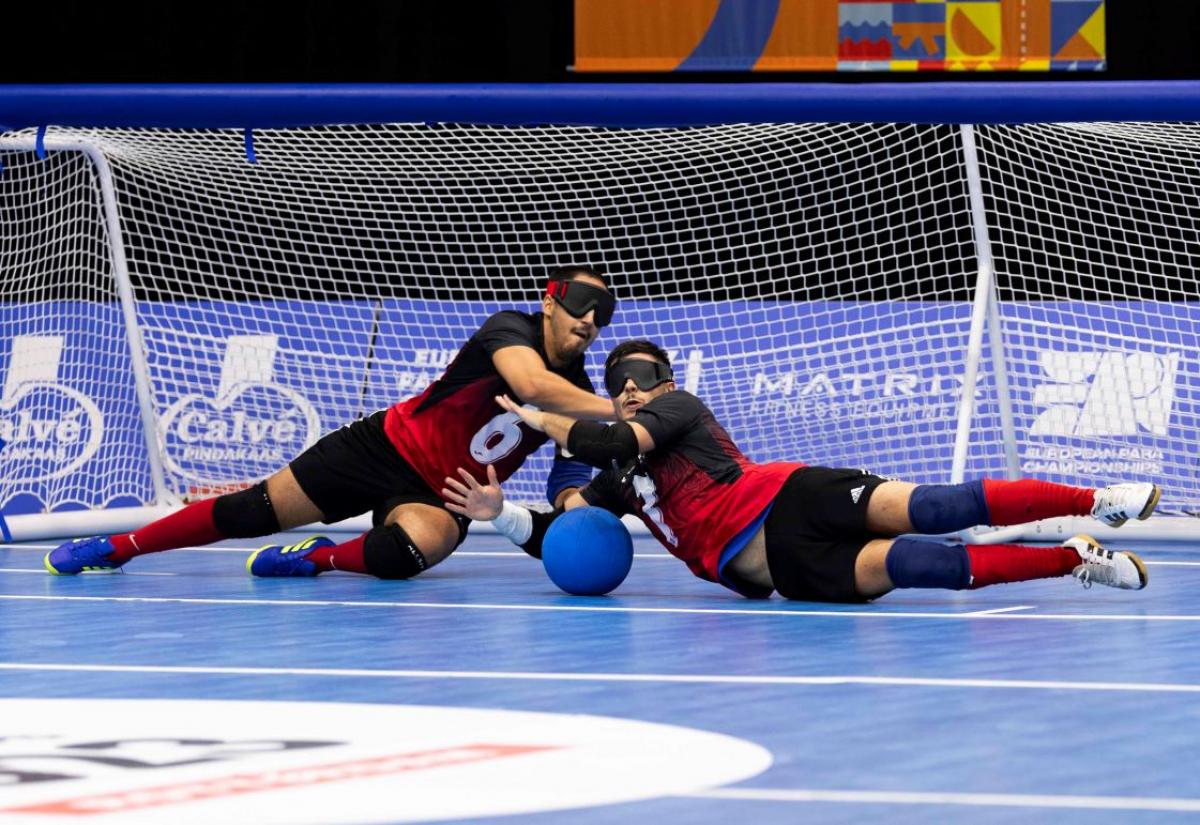
Since the mid-1940s, blind and visually impaired athletes have gathered around the world to compete in a sport that most people have never heard of, despite its treasured status in the disabled community. What makes goalball so remarkable–and so easy to overlook–is that it was never an adaptation of a traditional sighted sport. Instead, it was designed from the ground up to be played completely without vision. Three-player teams are stationed at opposite ends of the court to defend a heavy ball filled with bells from passing the goal line. During gameplay, every athlete wears blackout eyeshades to ensure that no player has an unfair advantage. It is a fast and intense sport–and the more people learn about it, the more they realize just how groundbreaking it was for the world of adaptive athletics.
The sport began in 1946, when occupational therapists Hanz Lorenzen and Sepp Reindle created it as a rehabilitation exercise for blinded WWII veterans. Their goal wasn’t just physical rehab–it was emotional recovery as well. Veterans needed something that improved coordination and focus, but they also needed a sense of purpose and belonging. Goalball provided both. What started as a therapeutic tool quickly grew into a competitive game that spread throughout Europe, eventually gaining enough momentum to earn a spot in the 1976 Paralympic Games. Once on the international stage, the sport paved the way for other adapted sports–such as beep baseball and 5-a-side soccer–each of which drew inspiration from goalball’s sound-based design and its emphasis on equality through blackout masks.
Still, despite its global reach and the decades of athletic achievement behind it, goalball remains largely unknown outside the blind and visually impaired community. Many people are surprised to learn it even exists. It is crucial that awareness is spread to promote visibility, funding, and opportunities for athletes who rely on well-supported programs to train and compete. Understanding its origins and significance can shift public perception, say advocates, because goalball didn’t just create opportunities–it reshaped the entire notion of what accessible sports could be. In proving that sports could be built intentionally around non-visual skill rather than being retroactively adapted, goalball became the foundation of blind sports and a model for how to design inclusive athletics. Today, goalball is symbolic of resilience, innovation, and equality in sports. This sport continues to bond athletes all over the world, offering not only competition but confidence, independence, and community. It may still fly under the radar, but that doesn’t make the impact small. Goalball’s legacy shows that when a sport is created with accessibility as its core, it has the power to transform how people think about ability, teamwork, and even the nature of athletic competition itself.